
- Details
- Category: Security News
Cybersecurity , Endpoint Security , Technology
'Operation Daybreak' Zero-Day Attacks Trigger Emergency Flash Update
Security experts are once again warning enterprises to immediately update - or delete - all instances of the Adobe Flash Player they may have installed on any system in the wake of reports that a zero-day flaw in the web browser plug-in is being targeted by an advanced persistent threat group.
See Also: Unlocking Software Innovation with Secure Data as a Service
The attacks first came to light earlier this week, when Adobe issued an alert that a previously unknown flaw in Flash, designated CVE-2016-4171, was being exploited "in limited, targeted attacks." The bug exists in Adobe Flash Player 21.0.0.242 and earlier versions - running on Windows, Mac, Linux, and Chrome OS - and "successful exploitation could cause a crash and potentially allow an attacker to take control of the affected system."
Adobe on June 16 then released an updated version of Flash that patches 36 separate vulnerabilities, including CVE-2016-4171.
"Pay close attention to the release and address as quickly as possible," says Wolfgang Kandek, CTO of cloud security firm Qualys, in a blog post, adding that these attacks are another excellent reason to be running Microsoft's freeware Enhanced Mitigation Experience Toolkit on all Windows systems. "If you have EMET on your systems you are protected," he says (see 5 Secrets to Security Success).
APT Attackers Target Fresh Flaw
The CVE-2016-4171 flaw was discovered and reported to Adobe by Kaspersky Lab researchers Costin Raiu and Anton Ivanov. The researchers say they spotted related exploits earlier this month, and that they appear to be part of a spear-phishing campaign, dubbed Operation Daybreak, that launched in March, and which has amassed at least two dozen high-profile victims. Kaspersky Lab says it's code-named the "relatively new APT group" behind the attacks "ScarCruft."
"Victims have been observed in Russia, Nepal, South Korea, China, India, Kuwait and Romania," the researchers say. "The group has several ongoing operations, utilizing multiple exploits - two for Adobe Flash and one for Microsoft Internet Explorer."
The researchers say that the group may also have been exploiting another zero-day Flash flaw, CVE-2016-0147, which Adobe patched in April, and that the group has also been associated with the so-called "Operation Erebus" attacks that used watering-hole attacks to distribute another Flash Player exploit, CVE-2016-4117, which was patched by Adobe in May (see Zero-Day Attacks Pummel IE, Flash).
For Operation Daybreak, it's not yet clear how the APT group has been exploiting victims. "Although the exact attack vector remains unknown, the targets appear to receive a malicious link which points to a hacked website where the exploitation kit is hosted," the researchers say. For the second stage of the attack, however, some victims have been seeing a document, named "china.pdf," that the researchers say is written in Korean and which details "disagreements between China and 'the North' over nuclear programs and demilitarization."
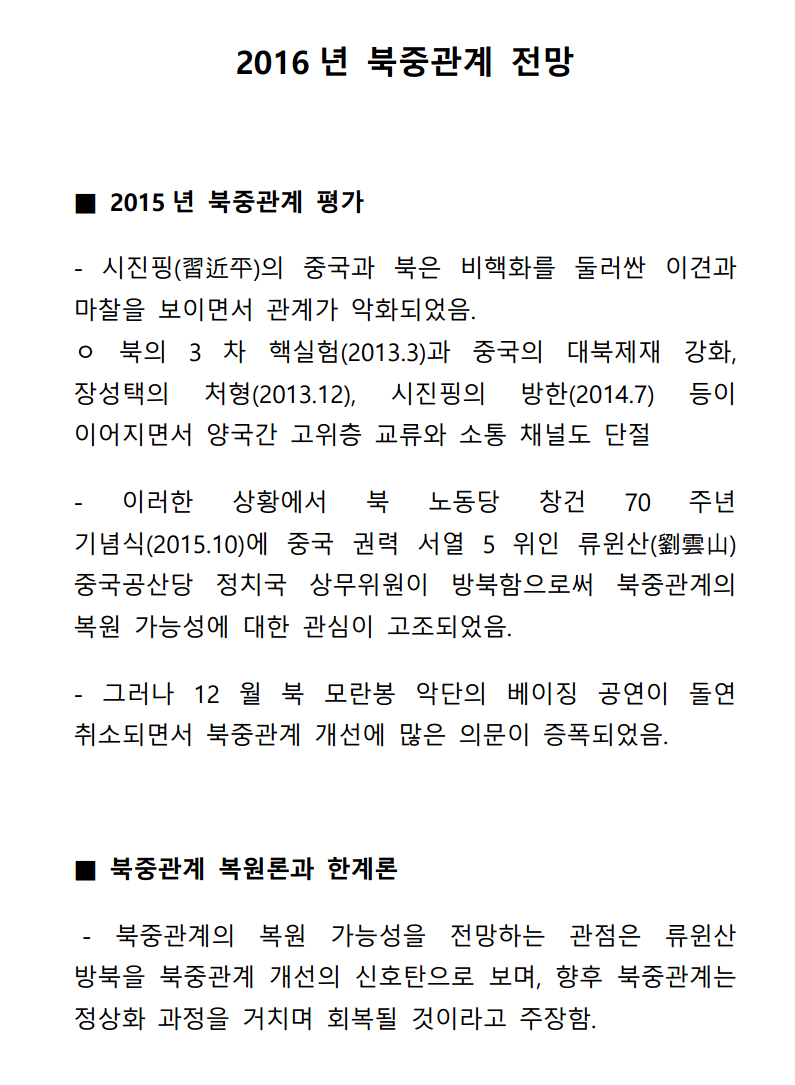 Decoy "china.pdf" file fed to Operation Daybreak victims by APT attack group "ScarCruft." (Source: Kaspersky Lab.)
Caution or Kudos for Adobe?
The latest warning over this campaign reinforces just how often APT attackers target Flash, thus making a potential business case for banning it for inside the enterprise. "This is the third month in a row that we are seeing a zero-day in Flash, making it most certainly the most targeted software on your organization's endpoints," Kandek says (see Emergency Flash Patch Battles Ransomware).
That may be true, although Kaspersky Lab reports that for 2015, four percent of all attacks it observed targeted Flash, which technology-wise took second place to Java, which was targeted in 14 percent of all attacks. But whether Flash comes first or second in hackers' hit list, the takeaway is that it's still a cheap and attractive target, since it can allow them to quickly and easily exploit millions of vulnerable PCs via highly automated attacks.
But Kaspersky Lab researchers Raiu and Ivanov, in their blog post on the Operation Daybreak attacks, contend that Adobe has been doing a good job of quickly patching flaws as they come to light, thus making related attacks more difficult to execute. "Nowadays, in-the-wild Flash Player exploits are becoming rare. This is because in most cases they need to be coupled with a sandbox bypass exploit, which makes them rather tricky," they say. "Additionally, Adobe has been doing a great job at implementing new mitigations to make exploitation of Flash Player more and more difficult. Nevertheless, resourceful threat actors such as ScarCruft will probably continue to deploy zero-day exploits against their high profile targets."
Unless users keep their Flash Player updated to the very latest version, however, Adobe's fast fixes are for naught, since their endpoints will remain easy pickings for any attacker, be they an APT group or cybercrime toolkit subscriber. As a partial defense, security experts have long urged users to at least enable "click to play" in Flash, so that attackers can't force Flash to launch and then remotely take control of PCs running vulnerable versions of the software (see 2016 Resolution: Ditch Flash).
- Details
- Category: Security News
Breach Preparedness , Data Breach , Events
CrowdStrike CEO George Kurtz Details Incident Response Essentials
Preparing for data breaches - to detect them quickly, respond appropriately and ascertain exactly what happened - can help make the difference between a security incident having major or minor repercussions, says George Kurtz, CEO of cybersecurity firm CrowdStrike.
See Also: Vulnerability Management with Analytics and Intelligence
"When you have an issue, what you're trying to really do is prevent the mega-breach," Kurtz says. "You might have somebody compromise a system or infect a system, but what you're trying to do is avoid those 200 days of having an adversary roam unfettered on your network, stealing intellectual property, or financial data or personally identifiable information."
Prevention, however, requires preparation, including honing an organization's breach-response plan in advance, as well as marshaling and training everyone who will be required to help respond. The same goes for technology - for example, being able to replay what happened on any given endpoint after a potential breach gets found.
"Knowing exactly what piece of malware - as an example - touched a particular document may either cause you to have to notify that you've been breached, or it may save you potentially millions, because you can ascertain and empirically prove that that document or data element wasn't touched," he says.
In this interview with Information Security Media Group conducted at the Infosec Europe conference in London, Kurtz also details:
Best practices for complying with the EU's new General Data Protection Regulation and related notification requirements; The importance of running tabletop exercises to help organizations hone their data breach response plans; The case for having an organization's legal team hire outside incident responders in advance of a breach; Factoring the potential for malicious insiders into incident-response plans.Kurtz is CEO of CrowdStrike. Previously, he served as the worldwide chief technology officer - amongst other roles - at McAfee, was also the founder and CEO of Foundstone, and developed the first ever internet penetration-testing methodology for all of Price Waterhouse.
- Details
- Category: Security News
The Federal Bureau of Investigation is now warning U.S. businesses of a new type of business email compromise scam, a.k.a. CEO fraud, that takes aim at personally identifiable information, rather than simply tricking accounting staff into scheduling fraudulent wire transfers.
See Also: How to Illuminate Data Risk to Avoid Financial Shocks
Additionally, the FBI has revised its tally of losses attributed to BEC attacks once again, putting worldwide fraud losses at more than $3 billion through the end of May. Just two months earlier, the agency said $2.3 billion had been lost to these scams between October 2013 and February 2016. Less than a year ago, it said losses were around $1 billion.
"Since January 2015, there has been a 1,300 percent increase in identified exposed losses," the FBI states. "The scam has been reported by victims in all 50 states and in 100 countries."
But in its June 14 public service announcement about the shifting focus of BEC attacks, the FBI notes that hacked email accounts linked to executives are now also being used to request personally identifiable information and W-2 tax forms from human resources and auditing departments.
Targeting PII was first seen earlier this year, prior to U.S. tax season, the FBI adds.
Email Authentication Won't Reduce Risk
To mitigate emerging risks, the FBI suggests companies implement two-factor authentication for email, which requires password entry and use of a dynamic PIN or code to log in to the email account.
"TFA [two-factor authentication] mitigates the threat of a subject gaining access to an employee's email account through a compromised password," the FBI says.
But experts say dual-factor authentication for email is not going to mitigate risks associated with BEC attacks, regardless of whether the attackers are after PII or want to schedule fraudulent wires. Because most BEC attacks are waged via spoofed, not compromised, email accounts, two-factor authentication will not mitigate risk, they contend.
"The majority of BEC attacks do not involve stealing the email password of executives," says Dave Jevans, vice president of mobile security at cyberthreat defense firm Proofpoint and chairman of the Anti-Phishing Working Group, a global coalition focused on unifying response to cybercrime. "BEC attacks involve sophisticated email spoofing. Two-factor authentication on the email of executives won't do much to solve this problem, and almost nobody has implemented 2FA on corporate email."
Rather than dual-factor authentication for email, companies should implement DMARC - Domain-based Message Authentication, Reporting & Conformance, which standardizes how email recipients authenticate emails through a uniform reporting mechanism, says Tom Kellermann, CEO of Strategic Cyber Ventures, a cybersecurity technologies investment firm.
"Businesses should mandate the use of DMARC and also require secondary, out-of-band authentication, like a text message or phone call, to validate a request for information or a transfer of funds," he says.
Bill Nelson, president and CEO of the Financial Services Information Sharing and Analysis Center, says companies also should enhance email security by using cryptographic techniques to secure emails. But Nelson agrees email authentication is not the answer.
"Financial institutions and their corporate customers can do a lot more to filter email and make sure that phishing emails don't get through," he says. "But in the case of BEC, we aren't talking about phishing; these are spoofed emails. I don't know that doing some sort of authentication of the email would help in that case. Verifying the legitimacy of the user would help. And if it is a spoofed email and not coming from the address of the executive or the business, then that is something that you should be able to detect in your email filtering system."
And in terms of reducing phishing, Nelson says most banking institutions and businesses are having more success mitigating their risks through employee education rather than technology.
At the end of the day, Nelson says the best way to reduce risk is to eliminate email approval for wire transfers and requests for PII.
Warning Comes A Little Late
Financial fraud expert Shirley Inscoe, an analyst at consultancy Aite, says there's really nothing new about the attacks the FBI references in its most recent alert.
"I've been hearing about it throughout 2016," she says. "I'm surprised it took the FBI so long to issue an alert, as this really does allow major access to PII data by crime rings. They will add this information to their massive databases, and match it up with payment card information from previous data breaches when possible."
Hackers also use PII data to perpetrate tax fraud, Jevans and Nelson say, which also is nothing new.
"Stealing of PII is so that scammers can file fake tax returns before the actual person does, and they can claim a refund," Jevans says. And if criminals file the fake tax returns through a tax preparation company or service, then they can have their refunds issued on debit cards - which means instant cash, he adds.
"They are using that PII for tax return fraud," Nelson agrees. "We heard about it last year, and most states are getting hit hard; they already sent a tax refund to someone that is clearly fraudulent. Now they have to clean it up."
But Inscoe says the industry should be worried about more than just tax fraud, especially since hackers are increasingly targeting PII through a number of different methods. "Access to this data will also make it simpler to commit identity theft and to impersonate customers when calling into contact centers. When they can do so successfully, they can get online credentials reset, order additional cards on accounts or obtain some other access device to commit financial fraud. Money is always the ultimate goal, whether it is to fund terrorism or just the product of greed."
Inscoe says businesses that fall victim to these types of BEC attacks must contact their banking institutions immediately, to ensure that employee bank accounts can be monitored for suspicious activity. "While most FIs [financial institutions] won't issue new cards due to the breach of PII, they can monitor the accounts of the employees whose data was breached more closely, place alerts on the accounts and take more care when asked to reset credentials or issue new cards," she says.
Not Technically Sophisticated
The schemes have stung countless companies. Attackers impersonate key executives or financial personal in companies and send emails to others in the organization ordering large wire transfers. (see Business Email Compromise: How Big Is the Problem?).
The scam is not technically sophisticated, but rather relies on social engineering. The hackers collect email account credentials through phishing schemes and then begin monitoring how employees communicate. In other cases, emails are spoofed to appear to come from an organization.
"Most victims report using wire transfers as a common method of transferring funds for business purposes; however, some victims report using checks as a common method of payment," the FBI says. "The fraudsters will use the method most commonly associated with their victim's normal business practices."
In addition to email authentication, the FBI also suggests businesses invest in intrusion detection systems that are tuned to catch emails coming from spoofed domain names that closely resemble the businesses' legitimate domains.
The FBI also advises businesses to register domain names that are close to the actual company domain name.
And, as a final precaution, the FBI says significant transactions should always be verified over the phone, not over email alone.
- Details
- Category: Security News
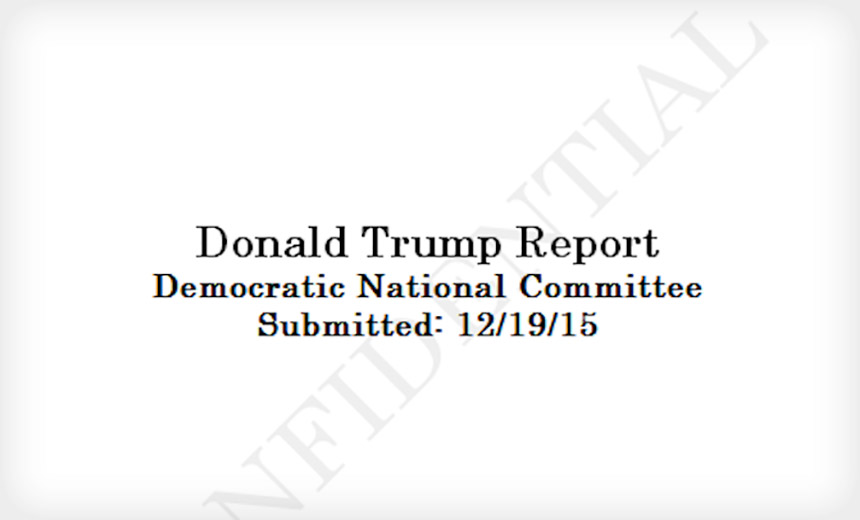 An alleged DNC background document dumped by Guccifer 2.0 (source: Gawker)
There's never any lack of lust for fame in the hacking world. Now one hacker, "Guccifer 2.0," has claimed sole responsibility for the breach of the Democratic National Committee's systems, posting a cache of documents on a public website.
See Also: Unite & Disrupt: Mitigate Attacks by Uniting Security Operations
It's a weighty, but as of yet unverified, claim following the DNC's disclosure on June 14 that its networks were breached (see Report: Russia's 'Best' Hackers Access DNC's Trump Research).
The DNC took the fairly unheralded step of allowing the computer forensics firm Crowdstrike to release public details of the intrusions just days after the hackers were booted from the network. Forensic clues point to two known groups nicknamed Cozy Bear and Fancy Bear, both of which may be linked to the Russian government, Crowdstrike believes.
Guccifer 2.0 claims on a newly-created WordPress blog to have hacked the DNC alone, extracting thousands of documents and emails that are now being transferred to the secrets-spilling website Wikileaks.
The alleged hacker took a dig at Crowdstrike, contesting the company's competency: "I'm very pleased the company appreciated my skills so highly. But in fact, it was easy, very easy." Efforts to reach the hacker were unsuccessful.
Crowdstrike is keeping Guccifer 2.0's claims at arm's length, saying it is confident in its conclusion of the source of the attacks.
"Whether or not this posting is part of a Russian intelligence disinformation campaign, we are exploring the documents' authenticity and origin," it said. "Regardless, these claims do nothing to lessen our findings relating to the Russian government's involvement, portions of which we have documented for the public and the greater security community."
Guccifer Legacy
The original Guccifer is Marcel Lazar Lehel of Romania. He accessed the email accounts of close to 100 prominent people, including former Secretary of State Colin Powell and the sister of former President George W. Bush. Lehel pleaded guilty in late May in U.S. federal court to aggravated identity theft and unauthorized access to a computer.
In the blog post, Guccifer 2.0 mentioned his namesake: "Guccifer may have been the first one who penetrated Hillary Clinton's and other Democrats' mail servers. But he certainly wasn't the last. No wonder any other hacker could easily get access to the DNC's servers."
More than One Hack?
The published documents include a meaty, 237-page Word document marked confidential and titled the "Donald Trump Report." It's a comprehensive background briefing on the presumptive Republican presidential nominee. The date on the document is Dec. 19, 2015.
The hacker contested the DNC's assertion no financial data was compromised in its breach. Also released was an Excel file that purports to be a list of high dollar Democratic party donors. According to one screenshot, actor Morgan Freeman of Los Angeles donated $1 million, and film producer Jeffrey Katzenberg $3 million.
Officials with the DNC couldn't immediately be reached. Gawker reported that the DNC is aware that the documents are circulating.
If the documents are genuine, it would indicate perhaps more than even two groups had access to the DNC's systems. This is not unusual. Security audits often find many pieces of malware on vulnerable systems, and it is possible that many actors or groups saw exploitable holes.
The development also doesn't mean that Guccifer 2.0 is necessarily affiliated with either Cozy Bear or Fancy Bear. In fact, state-sponsored cyberespionage groups have no interest publishing their stolen data publicly, as it's intended for internal consumption.
- Details
- Category: Security News
This edition of the ISMG Security Report kicks off with thoughts on how the Watergate break-in of the Democratic Party headquarters by operatives of President Nixon's reelection campaign 44 years ago today would have played out if current technology existed then. We might never had heard the word Watergate.
The Watergate anniversary comes the same week news surfaced of another breach - this one virtual - of the Democratic National Committee, in which Russian hackers allegedly accessed emails, chat conversations and opposition research on Donald Trump, the presumptive Republican presidential nominee.
You'll hear in this report (click on player beneath image to listen):
ISMG Managing Editor for Security and Technology Jeremy Kirk explain why the DNC and its security contractor CrowdStrike did something highly unusual: provide details about the breach. In my conversation with Jeremy, I explain why Russians hackers are so good at their job. DataBreachToday Executive Editor Mathew J. Schwartz points out that old internet protocols - including telnet and FTP - continue to be in widespread use, and used insecurely. BankInfoSecurity Executive Editor Tracy Kitten evaluates the war of words between bankers and retailers over national data breach notification legislation before the U.S. Congress.The ISMG Security Report appears on this and other ISMG websites on Tuesdays and Fridays. Please check out our June 10 and June 14 reports, which respectively examine the concerns expressed by security practitioners at the Infosecurity Europe conference in London earlier this month and analyzes Symantec's purchase of Blue Coat. The next ISMG Security Report will be posted Tuesday, June 21.
Theme music for the ISMG Security Report is by Ithaca Audio under a Creative Commons license.
More Articles …
Page 3446 of 3546