BayPay Forum BayPay Forum

Menu

  • Home
  • Events
    • Past Events
  • News
    • Payments News
    • Crypto News
    • Fintech News
    • Retail News
    • Fraud News
    • Regulation News
    • Security News
    • Markets News
  • Our Podcasts
    • Our Weekly Podcast
    • Our Daily Podcast
  • Join Us
  • Login
BayPay Forum BayPay Forum
  • Home
  • Events
    • Past Events
  • News
    • Payments News
    • Crypto News
    • Fintech News
    • Retail News
    • Fraud News
    • Regulation News
    • Security News
    • Markets News
  • Our Podcasts
    • Our Weekly Podcast
    • Our Daily Podcast
  • Join Us
  • Login

Step launches mobile banking app for teens, with parental controls

Details
Category: Mobile News
01 February 2019

Feb. 1, 2019

Step is launching a mobile banking app for teens, backed by $3.8 million in seed funding from CrossLink Capital, Collaborative Fund and Sesame Ventures, according to a press release.

Step, working in partnership with Evolve Bank and Trust, will offer traditional banking services via the app that allows parents to monitor teen spending. The bank is paying 2.5 percent interest on savings, no-fee access to 35,000 ATM machines, no overdraft fees and the ability to send and receive money through the app.

The bank also provides teens with a spending card that is linked to the app, allowing users to make mobile purchases, shop at retailers and make payments using Apple Pay.

"Teen expect instant services, but existing banks have failed to innovate and meet their needs," CJ McDonald, co-founder and CEO of Step, said in the release. "Most banks charge fees and implement rules and restrictions that hurt teens financial progress."

Step allows teens to request funds through the app and parents can send funds and get complete transparency over what their kids are buying through the mobile device.

Step is scheduled to launch this Spring and allowing teens and parents to sign up on a wait list. The Step platform, available for Android and iOS, will be rolled out to customers on a first-come, first served basis, according to the release.


Topics: Mobile Banking, Mobile/Digital Wallet, Mobile Payments

Companies: Step Mobile Inc., Apple

Sponsored Links:

Related Content

Latest Content

Original link

Fiction Riot, Decent to disrupt Hollywood with streaming video platform on blockchain

Details
Category: Mobile News
01 February 2019

Feb. 1, 2019

Fiction Riot, a startup specializing in short video, is partnering with Decent, a provider of blockchain technology, to create a "smart contract" platform that pays royalties directly to artists.

Fiction Riot is looking to disrupt the traditional model of Hollywood payment, by making instant, transparent payments for content streaming on its Ficto platform, according to a press release. The payments will be made on DCore, the Decent blockchain platform that runs up to 2,000 transactions per second.

"Streaming media services predominantly pay a single, upfront fee for the right to stream an existing or original film property, which essentially cuts the artists out of royalties on content that generates heavier viewership," said Mike Esola, co-founder and CEO of Fiction Riot, in the release.

He said blockchain will help "course correct" this compensation process, by using trusted, automated smart contracts that will "take the mystery out of artist compensation."

Ficto, scheduled to debut to consumers by spring 2019, allows creators to use a variety of technologies to create immersive video, including vertical video, 360 degree viewing, augmented reality, chat and live streaming, according to the release.


Topics: Bitcoin, Mobile Apps, Social Media, Technology Providers

Sponsored Links:

Related Content

Latest Content

Original link

Super Bowl LIII and Tampa Bay Rays lead push for cashless concessions

Details
Category: Mobile News
01 February 2019

Feb. 1, 2019

Super Bowl LIII and Tampa Bay Rays lead push for cashless concessions

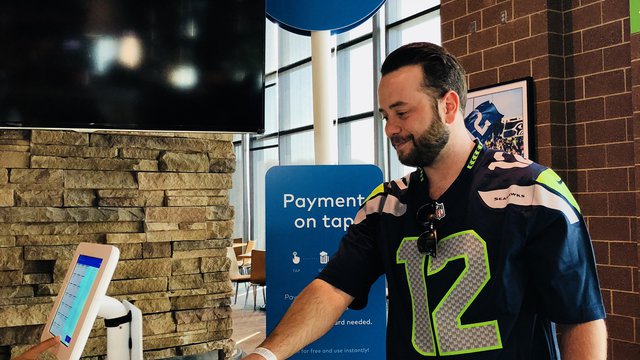
Seattle Seahawks fan using fingerprint scan from Clear to pay at concession stand

The Super Bowl has long been considered a proving ground for companies to launch products or raise brand awareness with hundreds of millions of viewers glued to their television around the world. However, during this Sunday's game in Atlanta, the National Football League and Visa are turning the venue into a test bed for cashless payment technology on a grand scale that has rarely been seen in the U.S.

The NFL and Visa are showcasing technologies at Mercedes-Benz Stadium here, including tap-to-pay terminals, that give fans the ability to buy food, drinks and merchandise without the need for cash. Visa is making its presence felt with kiosks and two NFL Shops at the Super Bowl Experience at the Georgia World Congress Center.

NY Giants star running back Saquon Barkley and San Francisco 49ers tight end George Kittle will be on site at the NFL Shop promoting tap to pay technology, by filming digital shorts to be posted on Facebook, Twitter and Instagram.

"Visa's plan to encourage cashless payments during the Super Bowl this year is a big step forward in creating a more frictionless experience for fans," Michael Jasczczyk, CEO of GK Software USA, said in an email. "No one likes to wait in a checkout line, and this is especially true when missing out on a big game."

Thad Peterson, a senior analyst at Aite Group, says the drive for increasing in-stadium mobile commerce is driven by a couple of major considerations, getting fans to get off the couch and instead of watching games on television, get them to buy tickets for live games and need for the technology to meet the demand.

"The first challenge that stadiums faced was providing enough bandwidth within the venue to support thousands of mobile devices and there has been a concerted effort to increase both wifi and mobile bandwidth at stadiums," he told Mobile Payments Today in an email. "The next step was to create a high value app that would provide information about the game, replays, commentary, etc., so that customers would see their phone as an addition of the experience."

Both Visa and NFL executives are banking on a successful expansion as they plan to roll out cashless payments to stadiums across the country over the next year. The move is part of a larger trend toward encouraging mobile technologies, including mobile wallets, smartphone based apps, wearables and biometrics, to be used to get fans parked, seated and ready to buy food, drinks and team merchandise using these new payment methods.

Cash-free ballgame

In late January, the Tampa Bay Rays announced plans to convert their home stadium, Tropicana Field, into the nation's first cash-free sports venue in North America. The transition includes everything from the concessions to the box office, team merchandise outlets and remaining point-of-sale locations.

Technology firm E15, a subsidiary of Levy, a Chicago-based hospitality firm that handles concessions at Tropicana Field, said contactless payment technologies have transformed the fan experience during pilot studies conducted at the stadium and other sports venues across the country.

"Across the board, we are seeing average transaction time cut in half when the shift is made to cash free, allowing fans to get back to their seats and enjoy the game," Jamie Faulkner, president of E15 Group, said in an email. "Lastly, mobile app or contactless POS allow our partners to personalize or customize food and beverage offerings to our fans through additional data insights."

The technologies include a range of contactless payment, kiosks and mobile express/in-seat ordering technologies, according to Faulkner. Fans will be able to pay with Apple Pay, Samsung Pay, Rays gift cards or major credit or debit cards. Fans using cash will need to exchange cash for Rays gift cards and then use those cards to make payment.

During the testing period last year, the Rays also converted its most active food hall near the third base line of the stadium to a cash-free zone. The company made several other changes during the test period by deploying kiosks that helped speed the wait times for fans.  

"All of that combined had us go from about a 55 percent cash footprint in the building at the start of last year to less than 25 percent cash by the last home stand," said Bill Walsh, vice president strategy and development for the Rays, in a phone interview.

Biometric payments

Clear, the biometric technology company that helped develop technology to speed travelers through airport security, is using that same technology to disrupt the fan experience at major football and baseball stadiums around the country.

Clear launched a pilot program in 2018 that allowed fans of the Seattle Mariners at Safeco Field (now T-Mobile Park), and the Seahawks at CenturyLink Field, to use fingerprint scans to pay for food and drinks at concession stands and also confirm their age while paying for beer.

It also launched a pilot program with MLB and Tickets.com at Citi Field, the home of the New York Mets to provide biometric ticket entry at the stadium, where fans could tap their finger to get into the stadium, instead of paper or regular mobile tickets, according to a spokesman.

The company has implemented the technology at Yankee Stadium in the Bronx, Marlins Park and American Airlines Arena in Miami, Coors Field in Denver and other stadiums and arenas across the country. The plan is to roll out the technology across MLB stadiums this season.


Topics: Card Brands, Contactless / NFC, Mobile Apps, Mobile Payments

Companies: Visa, NFL Enterprises LLC.

Sponsored Links:

Related Content

Latest Content

Original link

Climb raises $50M in funding from Goldman Sachs

Details
Category: Mobile News
31 January 2019

Jan. 31, 2019

Climb, a fintech company that helps students get financing, has raised $50 million in lending capital from Goldman Sachs Urban Investment Group.

Climb, which launched in 2014, has originated almost $100 million in loans, helping almost 10,000 students pay for their education, according to a press release. The company said it has worked with more than 100 different colleges and universities.

Climb uses a proprietary return-on-investment algorithm to connect students with a school program, using information like graduation rates, job placement rate, starting salaries and other information.

"We are excited to use this lending capital to strengthen and extend our offerings so we can help new students, career switchers and employees who need to up-skill," Angela Ceresnie, CEO of Climb Credit, said in the release. "The funding will allow us to find more people across the country build hard skill sets and transform their careers."


Topics: Financial News, Mobile Payments, Money Transfer / P2P

Sponsored Links:

Related Content

Latest Content

Original link

The growth of mobile POS and preventing fraud

Details
Category: Mobile News
31 January 2019

Jan. 31, 2019

The growth of mobile POS and preventing fraud

By Rafael Lorenco, executive vice president, ClearSale

Mobile point-of-sale (mPOS) devices are having a moment, with analysts predicting that the yearly number of mobile POS transactions will triple by 2023. Among the reasons: Prices are dropping for wireless POS units and plug-in card readers, and some POS vendors are expanding their product lines to offer mPOS technology. Cost-conscious small businesses, SMBs that sell at temporary or mobile locations, and brick-and-mortar merchants all stand to benefit from mPOS adoption—as long as they understand how to protect their data on these comparatively new systems.

How merchants are using mPOS tools


Some companies use dedicated mPOS terminals that can print receipts for customers, but the typical mobile point-of-sale setup is a smartphone or tablet with a payment-processing app and a card reader that plugs into the audio jack. This tech is ideal for small retailers and food vendors who sell at different locations like fairs, food truck courts, and farmer’s markets. It’s also helpful for service providers like HVAC repair technicians who can process payments on the spot at clients'homes and offices without having to phone in a credit card number or mail an invoice.

In physical stores, MPOS units can work as additions to a traditional POS terminal or replace it entirely, which is the case with some small businesses that use a tablet-and-reader setup instead of a dedicated POS terminal. Larger retailers with existing POS infrastructure—recently updated for the 2017 EMV liability shift in the US--have been slower than mobile and small businesses to adopt mPOS technology. But now, larger merchants are driving growth in the mPOS, which is expected to top 27 million devices by 2020. By untethering in-store payments from the checkout counter and allowing customers to pay anywhere in the store whenever they’re ready, retailers can reclaim floor space and increase sales, as women’s fashion chain Lilly Pulitzer has reported since it added mPOS capability for its In The Pink stores.

As more mPOS devices come into use, security and fraud experts caution that these tools carry their own set of data-safety and payment-fraud concerns, in addition to the challenges that all business face when accepting with card payments. Any merchant who uses mPOS or is considering it needs to be aware of what those risks are and how to reduce them.

Security and fraud considerations


One of the most obvious but overlooked risks with mobile point of sale systems is the risk of physical theft or loss . Despite advances in anti-theft technology, smartphones are still an appealing target for thieves  looking to resell them for a couple of hundred dollars apiece, even without the added temptation of access to a merchant payment account. Whether your business owns its own mPOS devices or lets employees bring their own devices (BYOD), make sure that every device used for mPOS can be remotely locked or wiped to deny thieves access to your data. A recent report found that only 56% of employees at many companies can remotely wipe sensitive data from their devices.

Malware on an employee’s smartphone or tablet puts your payment data at risk of exposure and corruption. Incredibly, more than 40 percent of companies with BYOD policies say they don't know if those devices are infected with malware. One solution is to require that employees use the security apps of your choice on personal devices they use for payments.

Hacking over open wireless networks is a factor in many device hijacking and account takeover attacks against individuals. Such attacks can impact your business if an employee’s device is hacked while your payment processing app is installed. To guard against this type of intrusion, discourage your team from using unsecured WiFi networks; make sure the payment service you use includes point-to-point encryption (P2PE) from the point of swipe or chip-card insertion to the data center; and set up a VPN for employees to use if they access other company services from their mobile devices.

These steps can also help protect your transaction data and account information from remote code execution and man-in-the-middle attacks enabled by vulnerabilities in bluetooth and mobile apps. In 2018, researchers were able to find a way to manipulate the value of magstripe transactions processed on mobile devices and to access card readers'operating systems. By exploiting these weaknesses, the researchers said hackers could collect enough data to clone customer cards for CNP fraud. The companies whose devices were tested said they were working on fixes. However, because security experts (and criminals) are always finding new vulnerabilities that can be exploited, make sure every mPOS device, yours and your employees’, is updated and patched whenever problems are announced.

All these mPOS security steps should be layered on top of the other anti-fraud and data-protection processes your company uses. As with dedicated POS terminals, any mPOS system you use should be PCI and EMV compliant to meet payment security standards and protect you from liability for card fraud. By taking precautions to protect your mPOS devices, your business can safely sell at more locations for a comparatively low cost while keeping your customer and company data safe.

Cover photo: iStock

Topics: Mobile Payments, POS, Trends / Statistics

Sponsored Links:

Related Content

Latest Content

Original link

More Articles …

  1. Clear secures funding from T Rowe Price, Revolution for airport, stadium expansion
  2. Ritual plans major expansion of mobile food ordering in Europe, North America
  3. Juniper Report warns contactless cards threaten growth of OEM pay in U.S.
  4. Stripe raises $100M from Tiger Global for international expansion, operations
  • 97
  • 98
  • 99
  • 100
  • 101
  • 102
  • 103
  • 104
  • 105
  • 106

Page 102 of 1447