
- Details
- Category: Security News

(This story has been updated.)
See Also: 2016 Social Engineering Report
Hackers apparently stole 2 billion rubles (US $31 million) from accounts that banks keep at Russia's central bank in a series of cyberattacks this year, according to several news reports. The news comes as the country's security service also claims to have fought off broader attacks against the financial services industry.
CNN reports that the central bank confirmed hackers tried to steal 5 billion rubles, but the central banking authority managed to stop them and redirect some of the funds. "We were lucky to return some of the money," a central bank spokesperson told CNN. The central bank did not say when the cyberheists occurred but said they took place over 2016, CNN reports.
Reuters reported that the bank released a report on Dec. 2 describing a cyberattack that involved "faking a client's credentials." Further details were not available.
The stolen money came from accounts held by banking clients at the central bank, The Wall Street Journal reported.
But Tass, the Russian news agency, claimed that the nation's central bank disclaimed the reports of money being stolen from correspondent accounts. "The reports about stolen two billion rubles from the Bank of Russia's correspondent accounts in a hacker attack are not true to life," TASS quotes the regulator's press service as saying. "[In] the review of financial stability, which was presented on Friday evening, the bank reported the losses commercial banks and their clients suffered in hacker attacks during the year 2016."
'Neutralizing' Other Attacks
Meanwhile, Russia's Federal Security Service says it has taken steps to "neutralize" attacks against its financial system. In a statement, the Federal Security Service said it had received information that large-scale cyberattacks were planned starting on Dec. 5.
The attacks, which allegedly were expected to strike several dozen Russian cities, would be accompanied by the mass sending of SMS messages and a social network and media campaign telegraphing a crisis in the Russian financial system, the Federal Security Service claimed.
The command-and-control server for the attacks is located in the Netherlands and is run by a Ukrainian hosting company called BlazingFast, the Federal Security Service also claimed. BlazingFast responded on Facebook that it had not been contacted by the Federal Security Service but would cooperate if its network was used for illegal activity.
"As soon as BlazingFast became aware of this report, we reviewed all our systems and network and we have not found any abnormal pattern changes that could lead to [Federal Security Service's] allegations," the company says.
SWIFT Related?
The apparent theft from Russia's central bank comes as cyberattackers have had success this year penetrating deeply into banks' networks. The most notable thefts have involved tapping into SWIFT, the financial messaging system used by 11,000 banks for international transfers. SWIFT, which stands for the Society for Worldwide Interbank Financial Telecommunication, is based in Brussels.
The largest SWIFT attack affected Bangladesh's central bank, which saw $81 million transferred from its account with the New York Federal Reserve to the Philippines. The attack used a combination of malicious software and deceptive tactics to exploit poor security controls. Hackers tried to transfer $951 million, but some transfers were blocked, one after someone noticed a spelling mistake (see Bangladesh Eyes Insider Angle for SWIFT Bank Attack).
In January 2015, $12.2 million was stolen from Banco del Austro in Ecuador after hackers accessed its systems and initiated SWIFT transfers. A Vietnamese bank, Tien Phong Commercial Joint Stock Bank, blocked an attempt to transfer $1.36 million from its accounts in late 2015 (see Another SWIFT Hack Stole $12 Million).
Banks have also seen sophisticated attacks, known as jackpotting, designed to reprogram ATMs to disgorge cash. Once in place, the malware allows hackers to trigger a withdrawal by inserting a special ATM card or sending a command via mobile phone (see 'Ripper' ATM Malware: Where Will Cybercriminals Strike Next?).
The Russian security company Group-IB says banks across Europe and Asia have been targeted lately in attacks that begin with spear-phishing emails. Those targeted email are crafted so that a victim will open a dangerous attachment or link that delivers malware (see Report: European Banks Struck by ATM Jackpotting Attacks).
Once inside a bank's systems, an ATM's software logic is changed. ATM vendors, including NCR and Diebold Nixdorf, have warned of these so-called logic attacks and advised banks on defenses.
Blowback
The targeting of Russia is not surprising given the mix of opportunist cybercriminals, politically motivated hackers and possible state-level actors worried about President Vladimir Putin's muscle flexing.
In October, the U.S. blamed Russia for hacking the Democratic National Committee along with the email accounts of party officials. The emails ended up on WikiLeaks and other websites, fueling unending media attention and further skewing an already unconventional presidential campaign (see Microsoft Says Russian DNC Hackers Targeted Zero-Day Flaws).
U.S. Vice President Joe Biden obliquely warned soon after the charge that the U.S. had the capacity to send a "message" to Russia and would do so when the circumstances have the greatest impact, according to The New York Times..
It's not clear if the U.S. has acted yet. In January, the U.S. Treasury directly accused Putin of being corrupt, alleging that he has amassed a fortune that has been masked through longtime training and practices, according to the BBC. U.S. spy agencies could conceivably be tasked with using offensive cyberattacks to expose Putin's finances.
Russia has consistently denied the hacking accusations while casting itself as a victim. In July, the FSB said malicious software infected 20 organizations, with targets including public authorities, scientific and military institutions.
- Details
- Category: Security News
×Close
Request to Republish Content
- Details
- Category: Security News
Anti-Malware , DDoS , DDoS Attacks
Botnet-Building IoT Malware Could Easily Infect Dozens of Model Types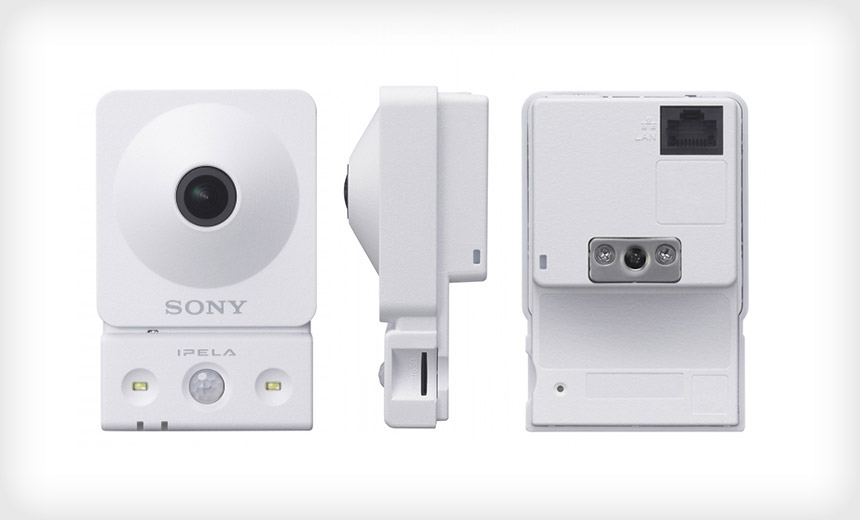 Vulnerable to Mirai malware until patched: Sony SNC-CX600
An information security consultancy says it has found three secret backdoors in more than 80 Sony IP cameras models that remote attackers could exploit to seize control of the devices.
See Also: 2016 IAM Research: Where Financial Institutions' PAM Programs Are Falling Short
Austria-based SEC Consult warns that there's a high chance that the cameras could be infected with the Mirai botnet code, which has infected millions of internet-of-things devices and been used to execute devastating distributed denial-of-service attacks (see Mirai Botnet Pummels Internet DNS in Unprecedented Attack).
But the vulnerabilities could also be used in more discreet ways, such as turning the cameras off or tapping into video streams to spy on people.
The software vulnerabilities and weaknesses affect Sony's IPELA Engine IP cameras, which are aimed at enterprise users. Sony has published an advisory detailing the vulnerable models and recommending the latest firmware version should be installed.
In a confidential document distributed by Sony to customers and obtained by Information Security Media Group, the Japanese multinational company says it has not detected any "damage" to its products as of Nov. 28. The document has not been publicly released.
Risk of Remote Exploitation
But here's the risk, according to SEC Consult's detailed security advisory: When set to their default configurations, the cameras are exploitable over the local network, and if the web interface is exposed to the internet, remote exploitation is also possible.
Sony says it is "grateful to SEC Consult for their assistance in enhancing network security for our network cameras." Sony officials that have been in touch with SEC Consult couldn't be reached for comment.
The consultancy's findings have been adding to experts' fears that many Linux-powered internet-connected devices running with loose security controls will remain a long-term problem if manufacturers don't improve their quality control.
Johannes Greil, a senior security consultant and head of SEC Consult's Vulnerability Lab, says his company hopes that vendors get their act together "and make more secure products out of the box and not actually harm their users."
Sony IPELA Engine IP cameras contain backdoor, allows an attacker to run arbitrary code & spy on you https://t.co/ETMOpla17M #sonybackdoor pic.twitter.com/d4HeGNkgnn
Assessing Security of Devices
To help IoT device users assess the security of their devices, SEC Consult has developed a tool called IoT Inspector that analyzes the devices' firmware - the relatively simple software that manages software and hardware interfaces on computers and devices.
Thankfully, Sony didn't make that all-too-common IoT manufacturer error of leaving remote access protocols such as telnet and SSH directly accessible from the internet. That's what resulted in the fast spread of the first incarnation of Mirai in September, as the malware sought out internet-facing devices and tried dozens of well-known default login credentials for accessible services to successfully seize control of numerous devices (see Can't Stop the Mirai Malware).
But the telnet and SSH protocols are still present in the IPELA Engine IP cameras. And SEC Consult found a way to reach them, thanks to other errors made by Sony.
For example, it's common for software developers to leave remote access accounts in software for debugging purposes, but it's considered a bad security practice because such accounts can be used to bypass device security. SEC Consult found three such accounts in the firmware, including one that allows for root access, which it's labeling a "backdoor" because the account isn't documented by Sony.
Hashes of the access credentials were also found by SEC Consult, which the company was able to crack. The Sony cameras run a web server called lighttpd. SEC Consult found it could use one set of access credentials to remotely access the web server and then start telnet. After that, an attacker would only need to upload Mirai malware to the camera to turn it into a botnet node.
An even more dangerous flaw, however, stemmed from SEC Consult uncovering the hash for the IP cameras' hardcoded root password. "We have not invested much time into cracking it, but cracking it is only a matter of time and computing power," SEC Consult's Greil says.
Once cracked, that password would give remote attackers access to a Linux shell and thus enable them to take full control of a device, overwrite the firmware with code of their own design, sniff all traffic flowing over the device and more.
Not Easy To Fix
While these problems have been identified, and Sony has released updated firmware, there's a catch: It appears that owners of the cameras will need to manually install the firmware updates. Greil says that involves using Sony's SNC Toolbox and rebooting cameras.
That's problematic because the cameras are usually plugged in and forgotten and are sometimes be placed in remote or difficult-to-reach locations. On the other hand, because these cameras are sold to enterprises, administrators may be more diligent in applying these must-have security fixes.
The firmware update takes between 10 to 20 minutes to install, according to Sony's confidential document.
Whether these vulnerable devices get patched at all, however, also depends on how well Sony can warn users that their devices contain known vulnerabilities, which relies in part on administrators having bothered to register the cameras with Sony.
Greil says SEC Consult hasn't yet vetted Sony's updated firmware, and notes that SEC Consult is still waiting for answers to multiple questions, such as how the backdoor accounts ended up in Sony's code. And he's criticized Sony's notification to users, contending that it doesn't allow affected customers "to make an informed decision about whether the risk justified an unscheduled patch."
Greil adds: "We had more questions to Sony in this regard, but they did not answer our inquiries."
- Details
- Category: Security News
 An image from a 2014 recruitment video released by Islamist extremists ISIS.
Facebook, Google, Microsoft and Twitter have promised to better identify and remove terror-related videos and imagery that get posted to their online properties by sharing information.
See Also: 12 Top Cloud Threats of 2016
The move will involve the firms contributing to a shared database that fingerprints images and videos that have been removed from Facebook, Twitter, Microsoft and Google's YouTube.
"Starting today, we commit to the creation of a shared industry database of 'hashes' - unique digital 'fingerprints' - for violent terrorist imagery or terrorist recruitment videos or images that we have removed from our services," the companies say in a shared statement issued Dec. 5. "By sharing this information with each other, we may use the shared hashes to help identify potential terrorist content on our respective hosted consumer platforms. We hope this collaboration will lead to greater efficiency as we continue to enforce our policies to help curb the pressing global issue of terrorist content online."
Each participating company will apply its own rules for what qualifies as "terrorist content." The companies also pledge that no personally identifiable information will be shared and say that the information will never be used to automatically remove any content.
The four U.S. technology giants say they're looking to involve more firms in the effort.
While the companies say that the move is an attempt to balance users' privacy with eliminating "terrorist images or videos" from their services, they note that they remain subject to government requests, meaning the identities of users who post or disseminate such content could be shared with authorities. "Each company will continue to apply its practice of transparency and review for any government requests, as well as retain its own appeal process for removal decisions and grievances," the statement notes.
Follows Efforts to Curtail Child Porn
Facebook tells the Guardian that the precise technological details of how the database will work have yet to be established.
But a similar project to battle child pornography is already in use. The Microsoft-based service, called PhotoDNA, was developed by Hany Farid, the chair of the computer science department at Dartmouth University. It's based on a stock library of millions of pornographic images of children maintained by the National Center for Missing and Exploited Children.
Numerous technology firms, including social networks and cloud providers, as well as governments and law enforcement agencies use the free service to help automatically track and remove such content, wherever it gets posted. The service is reportedly also effective at matching images even when they have been manipulated or cropped.
Responding to the new announcement from Facebook, Google, Microsoft and Twitter, Farid tells the Guardian that he and the Counter Extremism Project, a not-for-profit organization, have been in discussions with Facebook and Microsoft since January to adapt PhotoDNA to battle extremist content.
"We are happy to see this development. It's long overdue," he tells the newspaper. But he questioned the apparent lack of third-party oversight over the program, how frequently and thoroughly the database of hashes would be updated and the effectiveness of not automatically removing flagged content from every service that signs up to the program, as PhotoDNA does.
"If it's removed from one site, it's removed everywhere," he tells the Guardian. "That's incredibly powerful. It's less powerful if it gets removed from Facebook and not from Twitter and YouTube."
Targeting Illegal Online Hate Speech
The four firms say the latest effort to battle extremist imagery and videos has come about via regular meetings with EU officials as part of the EU Internet Forum, which was launched 12 months ago to battle terrorist content and hate speech online. The next meeting for the forum is due to take place later this week.
The move also follows Facebook, Google, Microsoft and Twitter in March signing up to abide by an EU code of conduct on "illegal online hate speech" that they helped create. While the code of conduct isn't legally binding, the firms committed to removing from European view the majority of related takedown requests - relating to hatred or promoting violence - within 24 hours.
That effort was led by Czech politician Vera Jourova, the EU commissioner for justice, consumers and gender equality, who pointed to the terror attacks in Brussels in March and Paris in November 2015, saying they "have reminded us of the urgent need to address illegal online hate speech."
"Social media is unfortunately one of the tools that terrorist groups use to radicalize young people and racist use to spread violence and hatred," she said. "This agreement is an important step forward to ensure that the internet remains a place of free and democratic expression, where European values and laws are respected."
White House Efforts
The move to remove terror-related imagery and videos from social networks also follows President Obama calling on Silicon Valley last year to help law enforcement agencies better monitor "the flow of extremist ideology" on their networks. Top White House officials met with Apple, Facebook, Microsoft and Twitter in January to explore better ways for combatting the online dissemination of terrorism-related content.
Despite such efforts, some politicians and legislators continue to publicly blame social networks for serving as virtual safe havens for terrorists and related ideologies (see UK Labels Facebook A Terrorist 'Haven'). Political critics, however, contend that turning technology giants into scapegoats is easier than admitting that domestic legislative efforts or a lack of funding for police or intelligence services might be contributing factors.
- Details
- Category: Security News
×Close
Request to Republish Content
More Articles …
Page 3540 of 3545